Landslide or Coin Flip / design diagrams
Decision flows, supporting boards and model evidence. All shapes, labels and connected arrows are editable in the native Excalidraw files. Open a downloaded file in Excalidraw to revise it. SVG and PNG exports are ready to share.
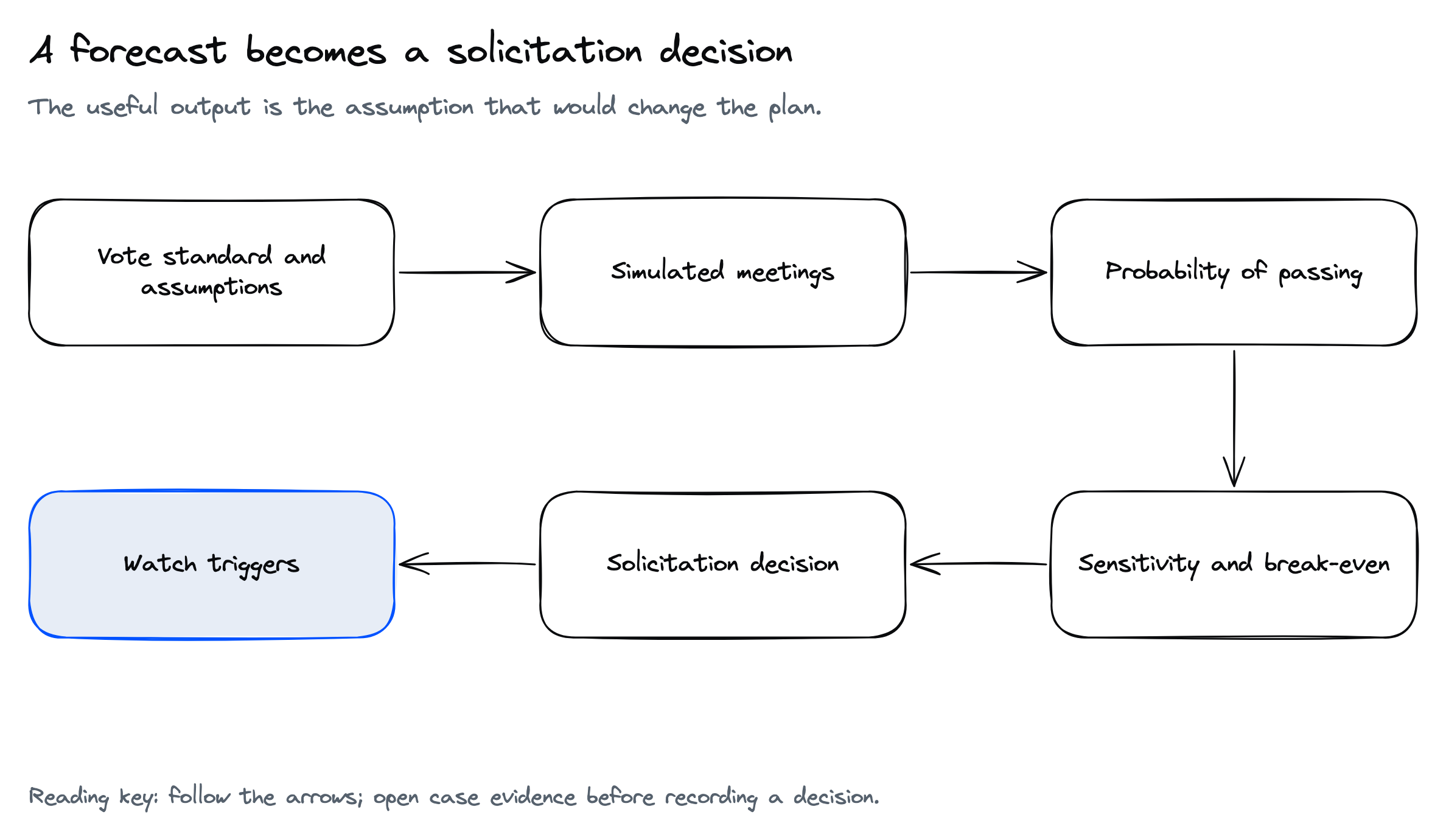
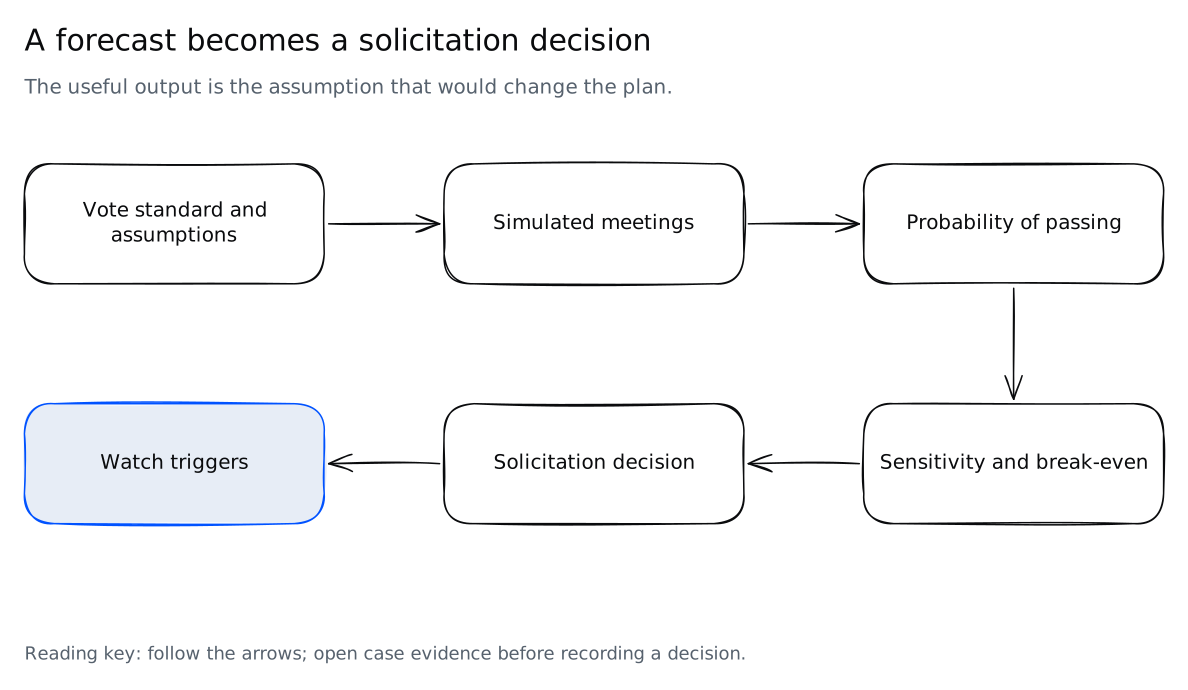
A forecast becomes a solicitation decision
The useful output is the assumption that would change the plan.
Read the diagram as text
- Choose a voting standard
- State turnout, support and shared-factor assumptions
- Simulate meetings
- Find the breaking assumption
- Record solicitation and watch triggers
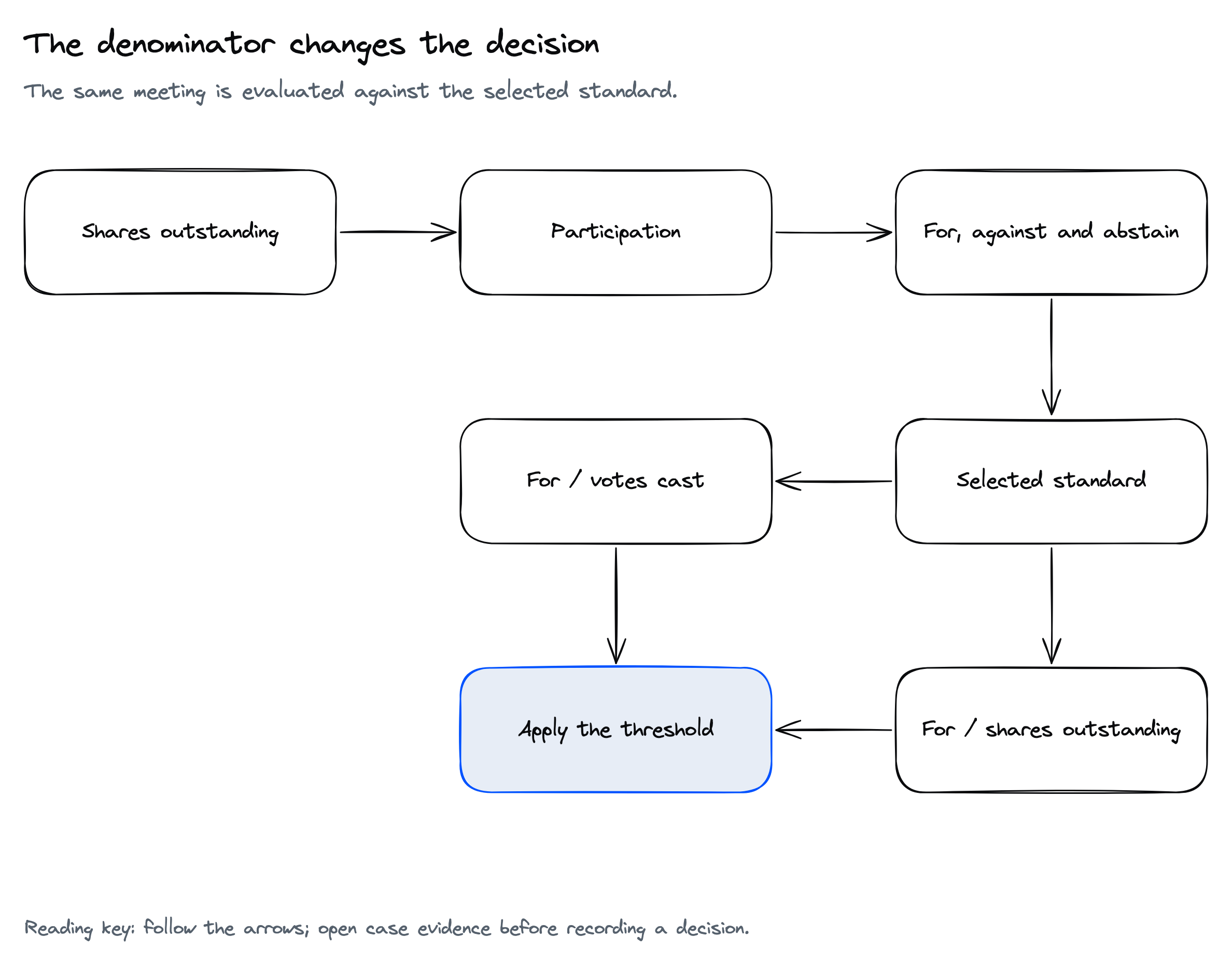
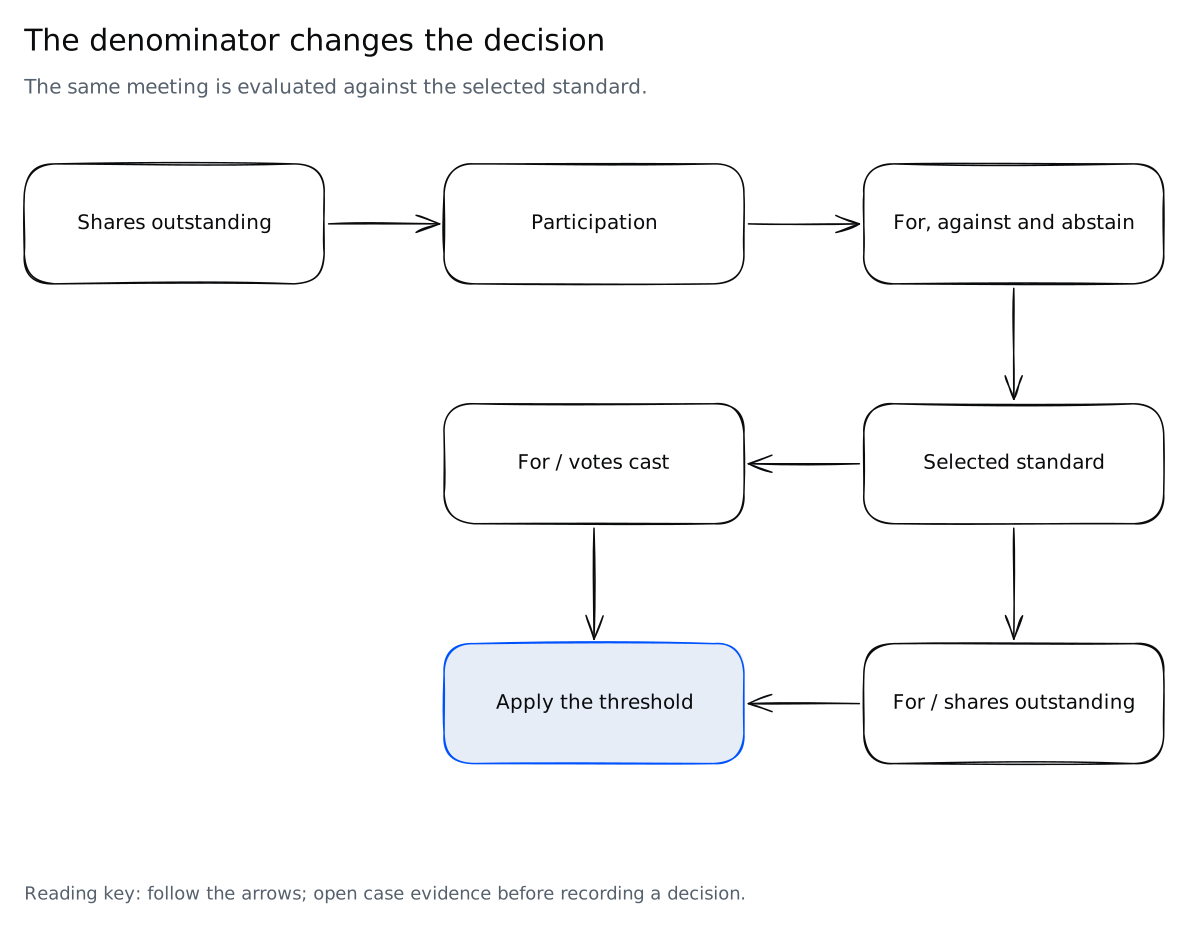
The denominator changes the decision
The same meeting is evaluated against the selected standard.
Read the diagram as text
- Outstanding shares define the full population
- Participation produces cast votes
- Abstentions are excluded from the cast-vote denominator
- Evaluate for votes against cast votes or outstanding shares
- Apply the exact selected threshold
A denominator is part of the voting rule
The same meeting can produce different decision ratios
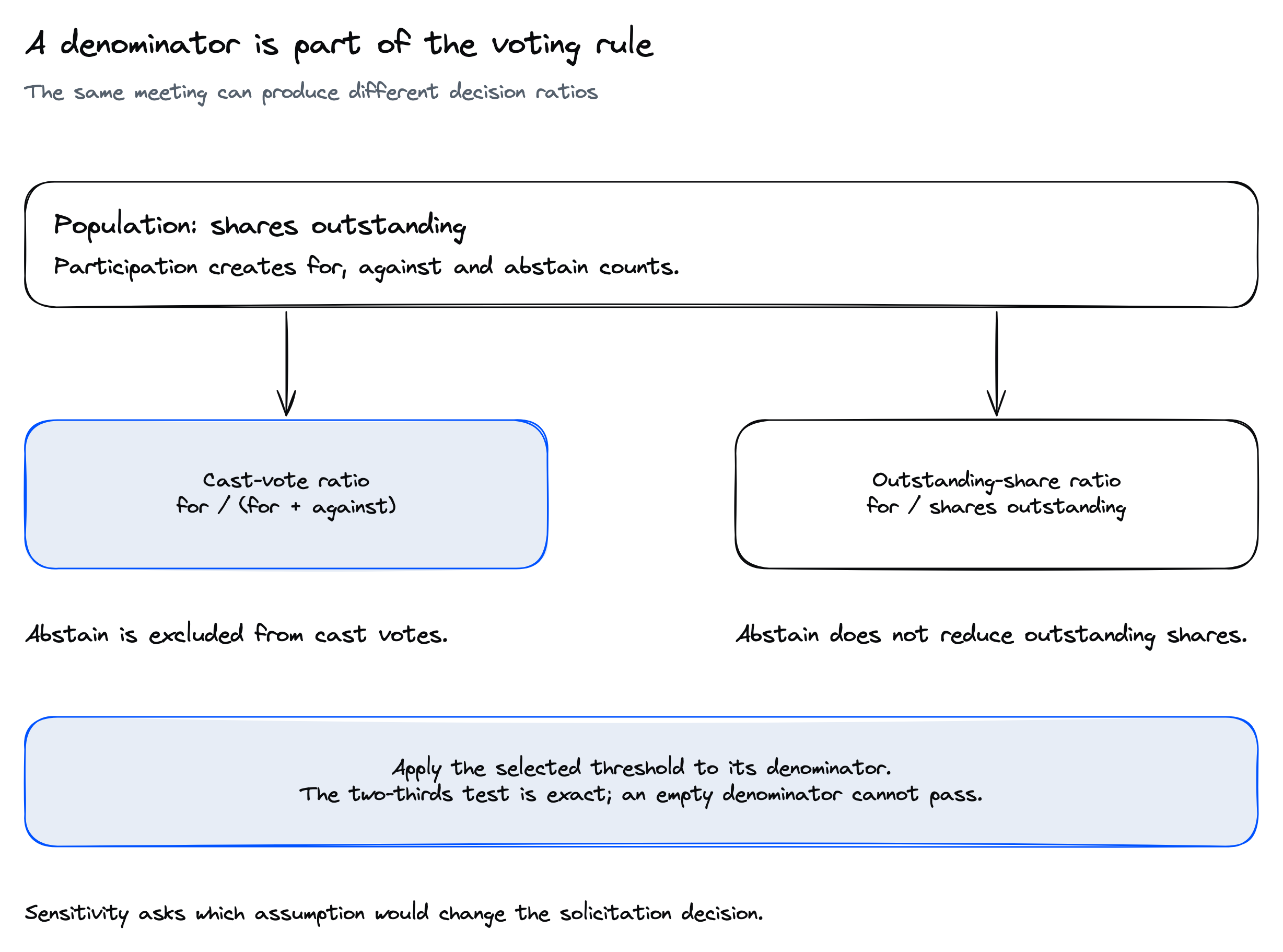
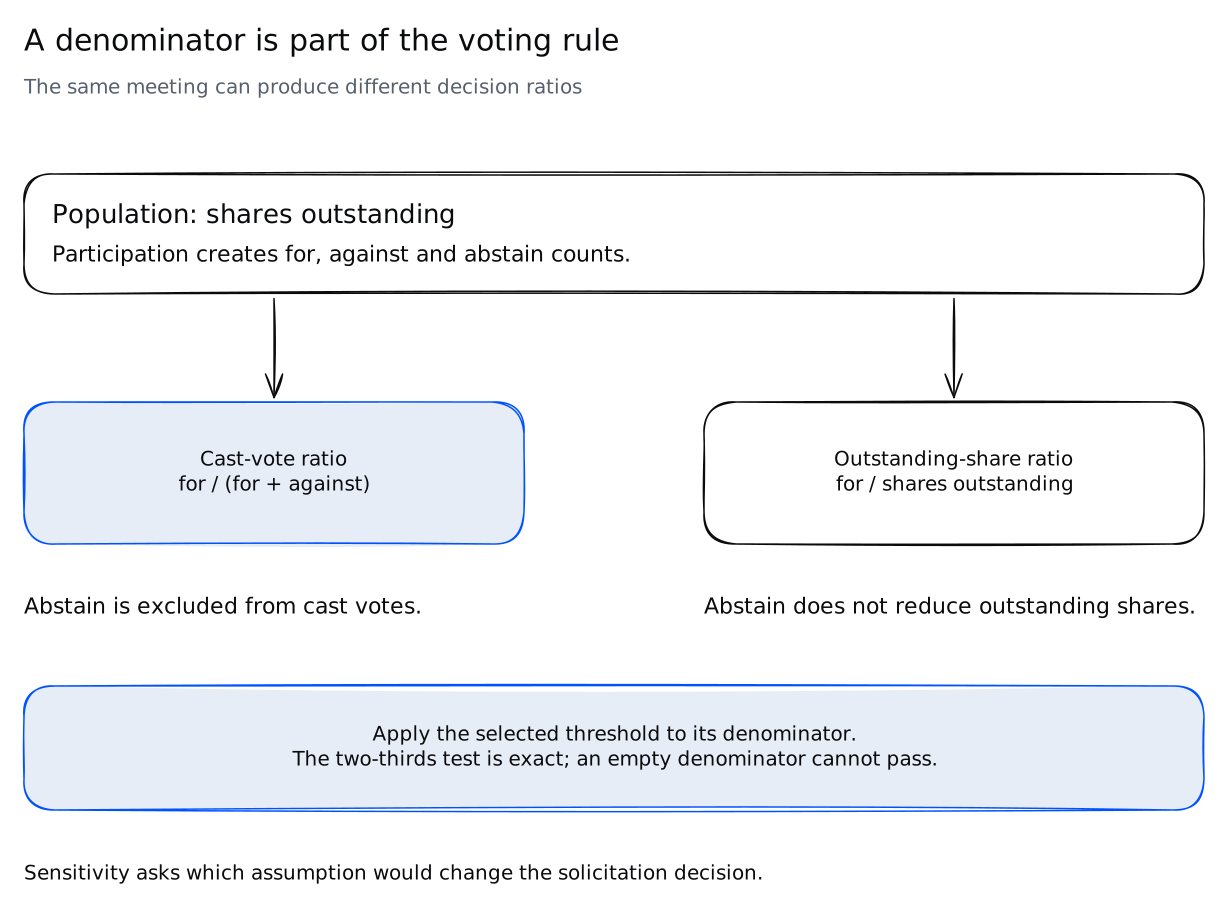
Read the diagram as text
- Population: shares outstanding
- Participation creates for, against and abstain counts.
- Cast-vote ratio
for / (for + against) - Outstanding-share ratio
for / shares outstanding - Abstain is excluded from cast votes.
- Abstain does not reduce outstanding shares.
- Apply the selected threshold to its denominator.
The two-thirds test is exact; an empty denominator cannot pass. - Sensitivity asks which assumption would change the solicitation decision.
Forecast to decision / assumptions remain visible
Default seeded model check; probabilities are simulation outputs
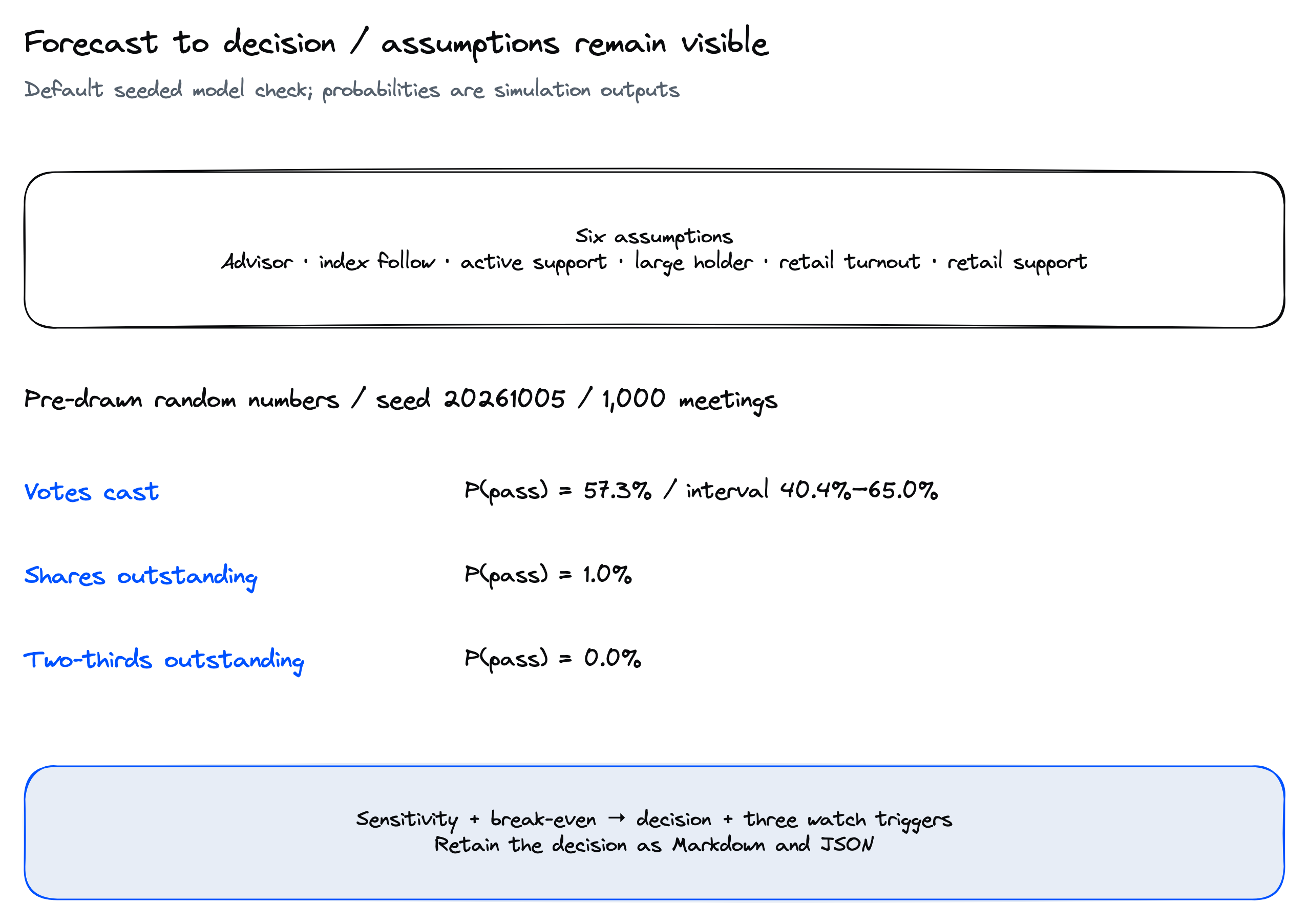
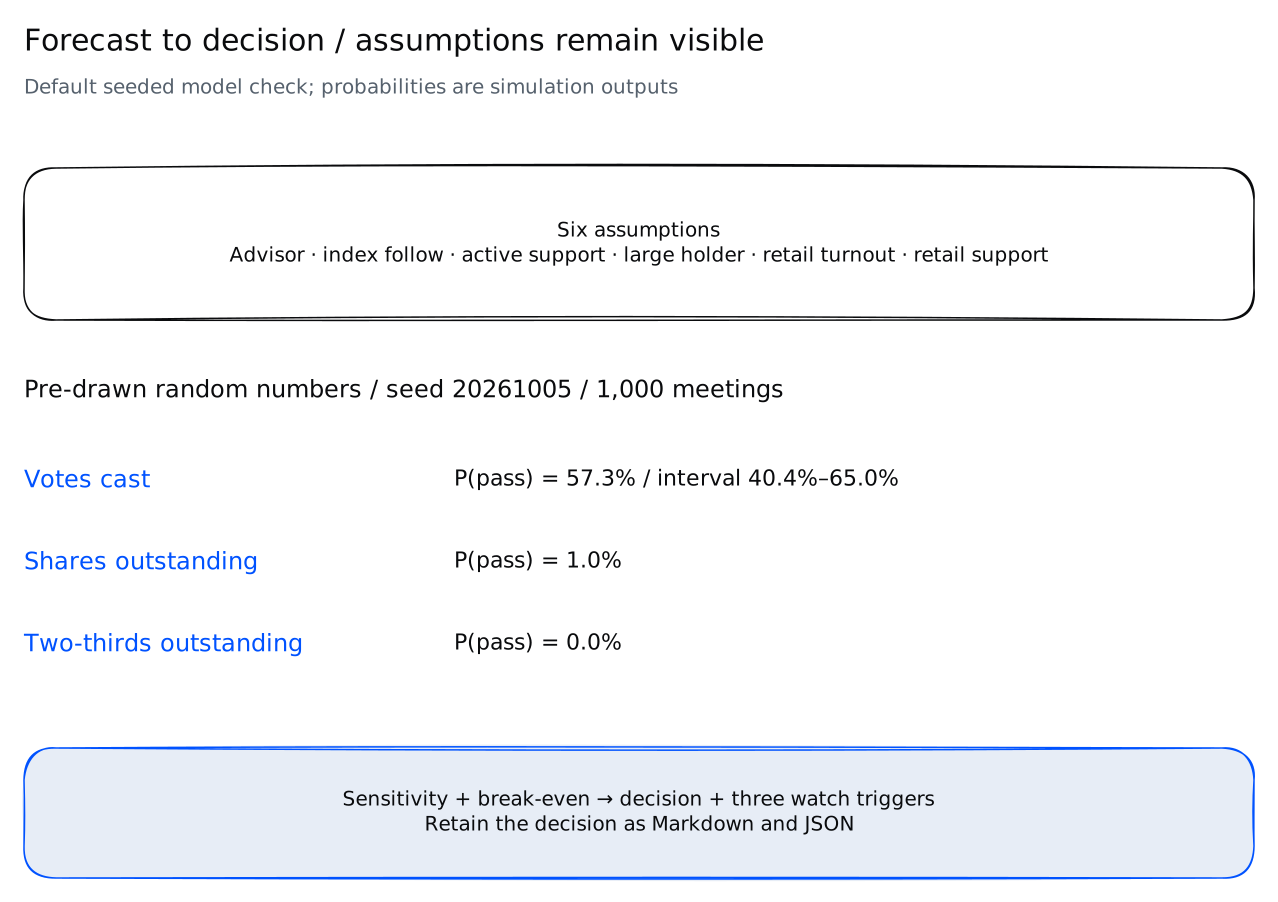
Read the diagram as text
- Six assumptions
Advisor · index follow · active support · large holder · retail turnout · retail support - Pre-drawn random numbers / seed 20261005 / 1,000 meetings
- Votes cast
- P(pass) = 57.3% / interval 40.4%–65.0%
- Shares outstanding
- P(pass) = 1.0%
- Two-thirds outstanding
- P(pass) = 0.0%
- Sensitivity + break-even → decision + three watch triggers
Retain the decision as Markdown and JSON
Voting standards / numerator, denominator, threshold
A normalized meeting of 100 outstanding shares; abstain remains separate
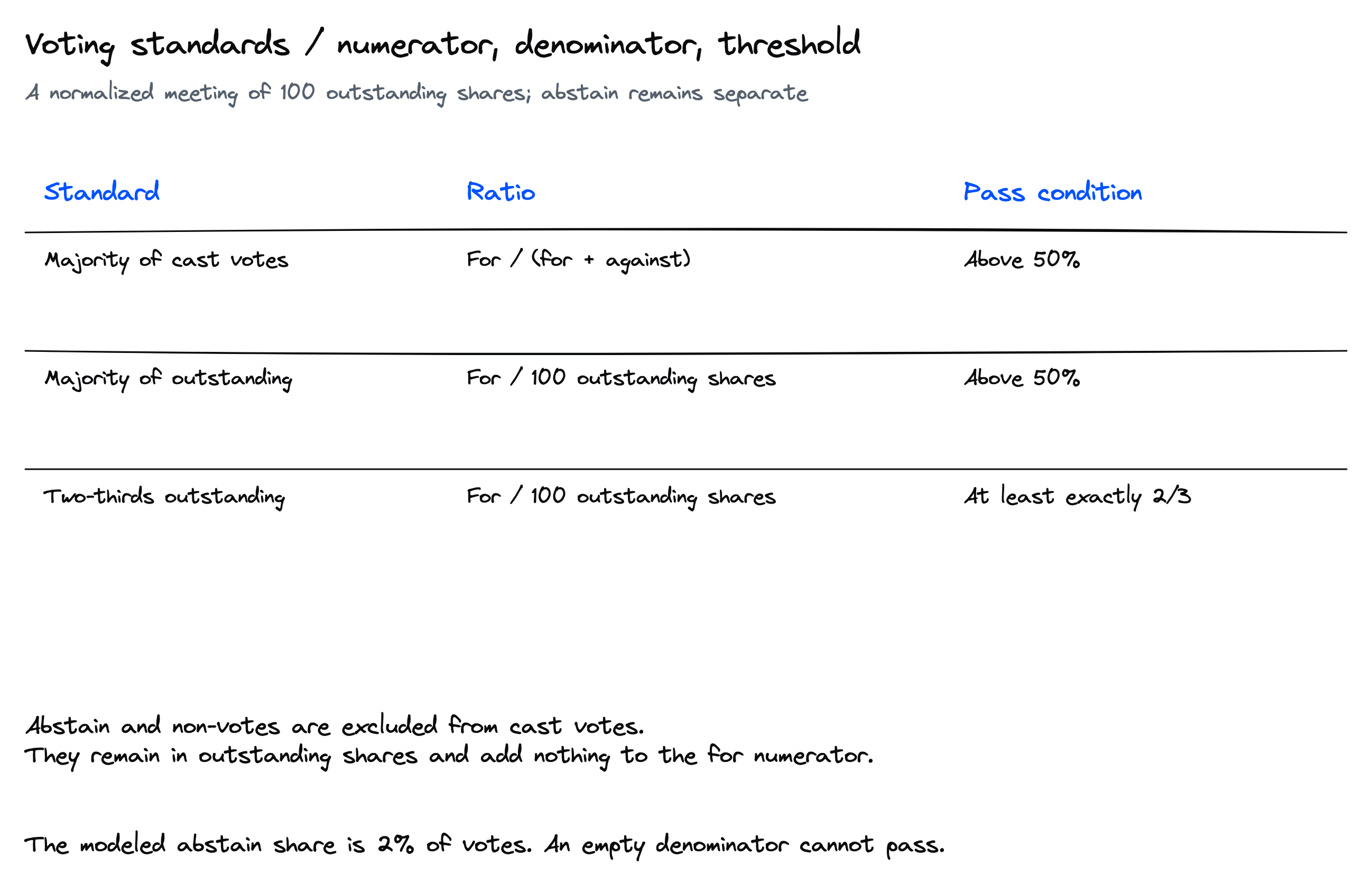
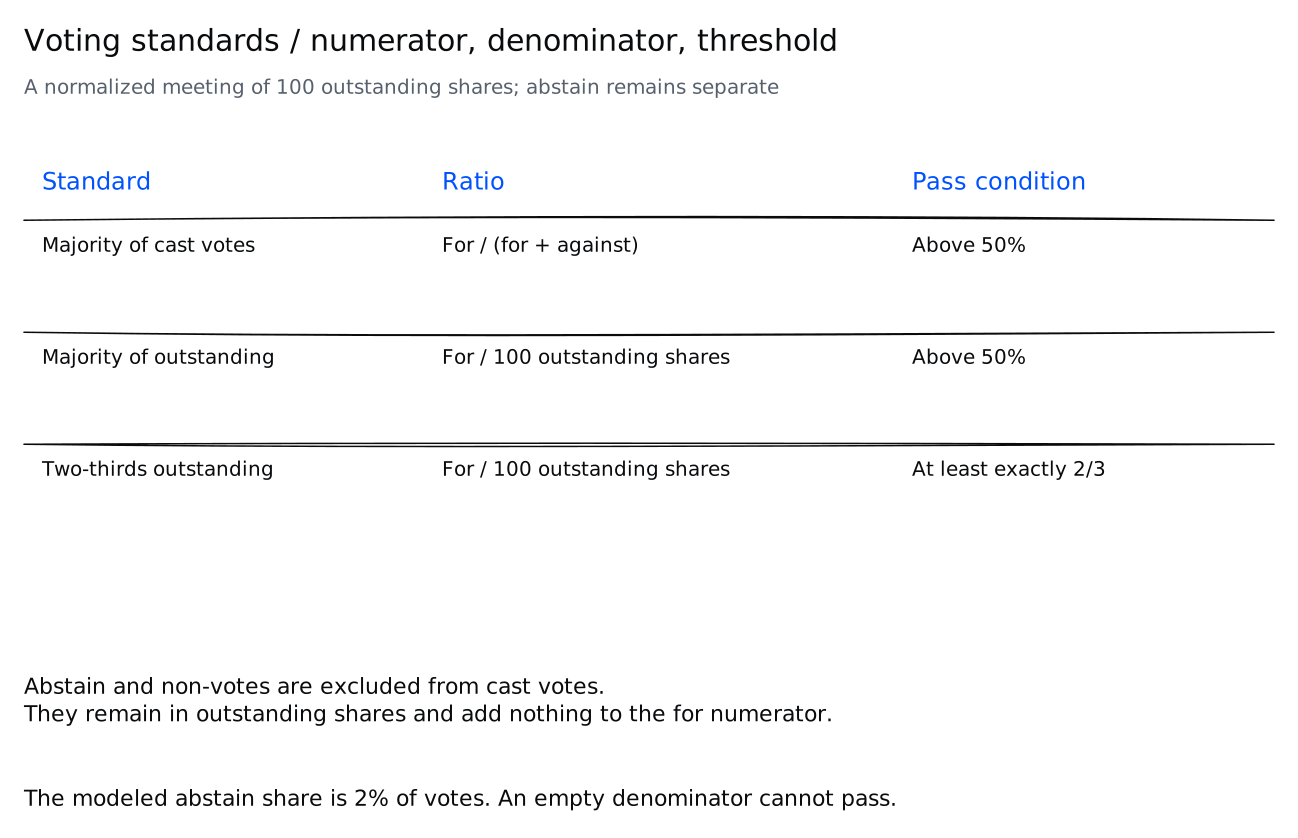
Read the diagram as text
- Standard
- Ratio
- Pass condition
- Majority of cast votes
- For / (for + against)
- Above 50%
- Majority of outstanding
- For / 100 outstanding shares
- Above 50%
- Two-thirds outstanding
- For / 100 outstanding shares
- At least exactly 2/3
- Abstain and non-votes are excluded from cast votes.
They remain in outstanding shares and add nothing to the for numerator. - The modeled abstain share is 2% of votes. An empty denominator cannot pass.
Changing the standard changes the influential assumption
Default sensitivity sweep; swings are modeled percentage-point changes
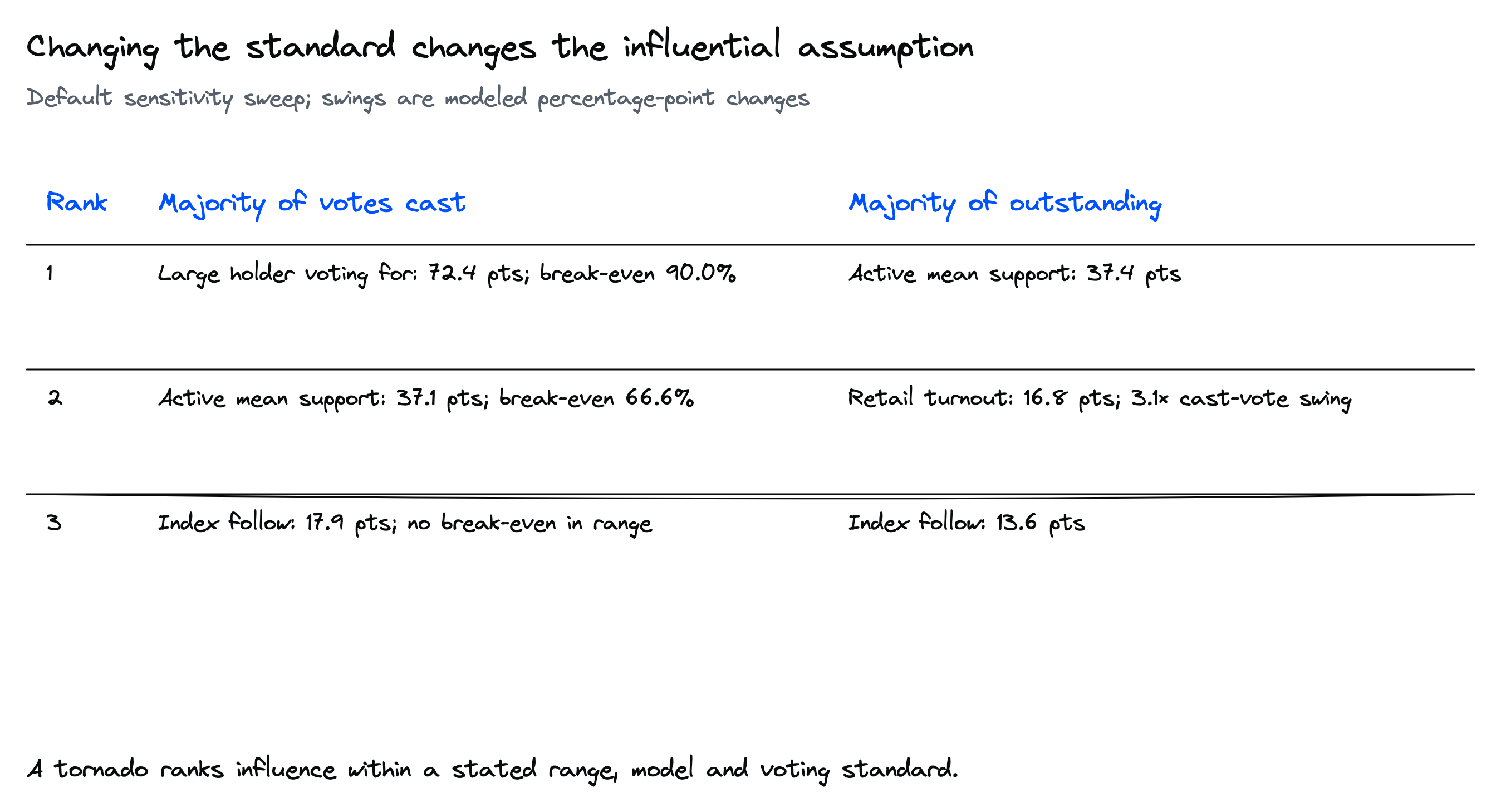
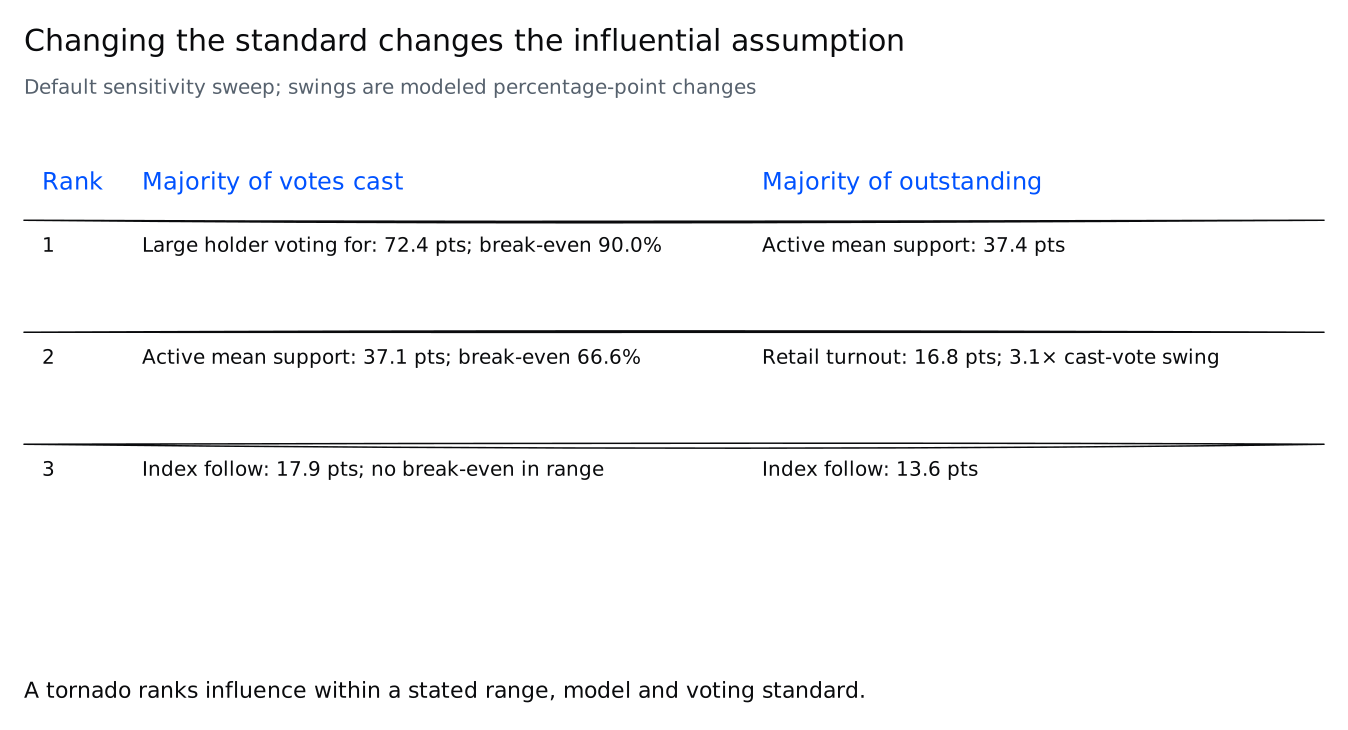
Read the diagram as text
- Rank
- Majority of votes cast
- Majority of outstanding
- 1
- Large holder voting for: 72.4 pts; break-even 90.0%
- Active mean support: 37.4 pts
- 2
- Active mean support: 37.1 pts; break-even 66.6%
- Retail turnout: 16.8 pts; 3.1× cast-vote swing
- 3
- Index follow: 17.9 pts; no break-even in range
- Index follow: 13.6 pts
- A tornado ranks influence within a stated range, model and voting standard.