
Itemized Haircut
A collateral analyst has to say whether an asset can secure a loan, and on what terms. The haircut table answers with 1 number per asset class. I built a workspace that draws the haircut as the sum of its evidence, from 6 evidence controls, and moves each risk to the lever that handles it: haircut points, a limit, a review date, or exclusion. On this data, a haircut sized from price history alone fails 2 of the 5 risky assets and passes the other 3.
- Collateral management
- Capital markets
- Credit risk
- Data visualization
- Eligibility schedules
- Information design
1 number, 6 arguments
01 · Failure contextA haircut protects the lender against 2 things at once: how far the price can fall before the position can be sold, and what selling it costs. Schedules print it per asset class. The analyst who has to defend it for 1 asset sees a single number with no arguments attached.
2 failures follow. A haircut sized from price history is blind to risks that are not in the history: a mark that stopped moving, a release that has not happened yet, a holder base that can leave at once. And some risks do not belong in the haircut at all: a position that is too large to sell is better handled by a limit, and a known future event by a review date.
- Role
- Product designer. I designed the collateral review, evidence controls, risk-to-lever routing, and eligibility schedule.
- Workflow
- Collateral eligibility: decide which risks need a larger haircut, a smaller pledge, an earlier review, or exclusion.
- Data coverage
- 6 assets pledged at 25 million USD each, a 5-business-day liquidation horizon, and a 30-day review horizon.
- Verification
- Shared model checks reconcile each schedule row with its evidence and coverage calculation. The review protocol tests risk routing.
- Related products
- Nasdaq Calypso covers eligibility and concentration constraints; Finastra connects collateral configuration and monitoring. Here, each adjustment opens the evidence that prompted it.
Inspiration. My July 2025 series of 3 posts proposing 30 risk widgets, linked in section 05.
Draw the haircut as the sum of its reasons, and put each risk on the lever that actually handles it.
The 6 questions before an asset counts as collateral
02 · ScopeIs the price real? The primary mark against a basket of independent sources, with a drift threshold and a consecutive-day count.
What does selling at this size cost? Exit cost in points as a function of size, against a norm for the asset class.
Does it hold its target? Days below a floor and the deepest excursion, for assets that trade around a par, a net asset value, or a peg.
Is a large release coming? Locked-up shares unlocking inside the review horizon, as a share of free float.
Who else could leave at once? Holder concentration: the top 3 holders as a share of units outstanding.
If it falls, does the haircut cover the fall and the sale? The consequence check: the under-water distance against the historical distribution of horizon drops, with the exceedance count.
Base · evidence · lever · consequence · schedule row.
Route the risk to the right lever
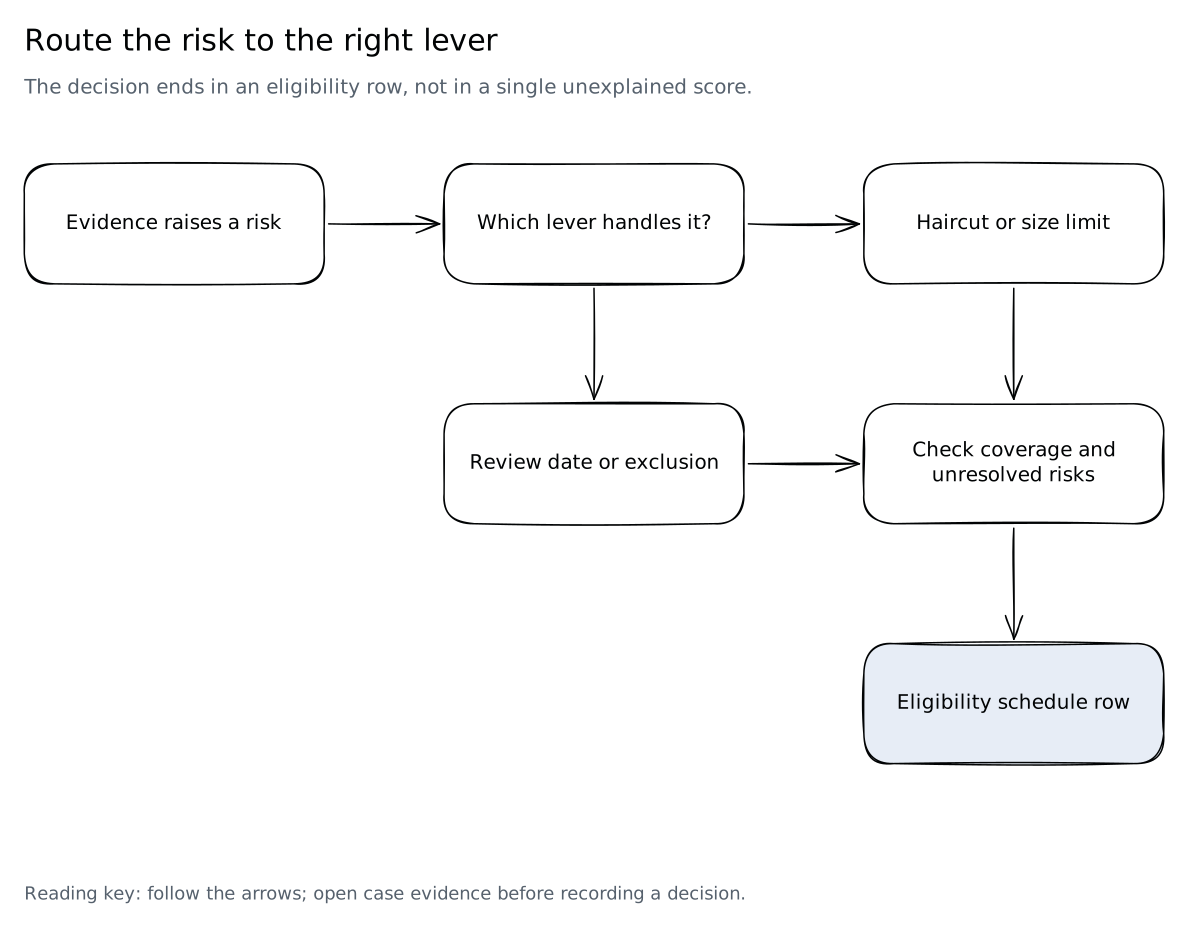
Read the decision flow
- Inspect the price, liquidity, timing and concentration evidence
- Choose the policy lever that addresses the risk
- Recompute collateral coverage
- Keep unresolved risks visible
- Commit the asset eligibility row
1 asset, 6 controls, 4 levers
03 · The prototypeThe review screen holds the 6 candidate assets on the left with class, pledge, and status. The center draws the itemized haircut as a waterfall: the class base, 1 bar per raised risk, the final total. Every bar opens its evidence panel below, and a consequence panel asks the only question that matters: would this haircut have covered the asset’s worst historical moves plus the cost of selling? The right column routes each raised risk to 1 of 4 levers and shows the schedule row that results.
Each risk can take the levers that fit it. A disputed price goes to haircut points, which also re-marks the asset to the basket, or to exclusion. A size-driven exit cost goes to points or to a pledge cap. A broken peg goes to points, to a review date that keeps the risk in the haircut, or to exclusion. A coming release goes to points or to a review date after the release; the second choice accepts the release risk until that review and records it as accepted, not removed. A concentrated holder base goes to points, to a cap on the pledge as a share of units outstanding, or to exclusion. Every assumption behind the numbers is editable in the tool and labeled as an assumption for the study, not a real schedule.
Authored inventory, counted from the data file
These are not user outcomes. They are counts the generator writes and the workspace reads, so each one can be checked in the schedule inside the tool.
Itemizing the municipal bond, and 3 levers
04 · A worked traceThe municipal revenue bond carries a class base of 7 points. The coverage test at base passes: the drop that would use up the haircut after exit cost sits well above the 99th percentile of the bond’s historical 5-day moves. The price check then shows what the pass is worth. The primary mark has not moved for 9 business days while the independent basket fell 2.4%. Today’s mark overstates the asset by about that much, and no historical window can show it, because the history is the flat mark itself.
The rule proposes 4 points: the current drift rounded up to the next whole point, plus 1. Routing the risk to haircut points adds the bar and re-marks the asset to the basket median, so the consequence panel now measures the haircut against a price that reflects what the asset would actually fetch. The add-on then covers the uncertainty left in a basket-derived mark, not the drift the re-mark already removed. The schedule row that results reads: eligible, haircut 11 points, re-marked to the independent basket.
The other risky assets show why the levers exist. The corporate bond’s exit cost at 25 million is 4.5 points against a class norm of 1, which fails coverage at base. Adding 3.5 more points would work; capping the pledge at about 1.2 million USD, where exit cost meets the norm, handles the size problem with a size limit and leaves the class haircut honest for every other corporate bond. At this pledge size the cap is close to an exclusion, and the schedule row says so.
The equity’s price history is clean, and it passes at base. Its release calendar is not: 38% of free float unlocks inside the 30-day review horizon. Routing that risk to a review date after the release takes the points out of the haircut and writes the row as risk accepted until that review, not removed. A committee that will not carry the unlock unprotected keeps the points instead. The fund share passes coverage with room to spare, but its top 3 holders own 71% of units outstanding; a concentration limit on the pledge handles what a deeper haircut would only price.
What collateral coverage means
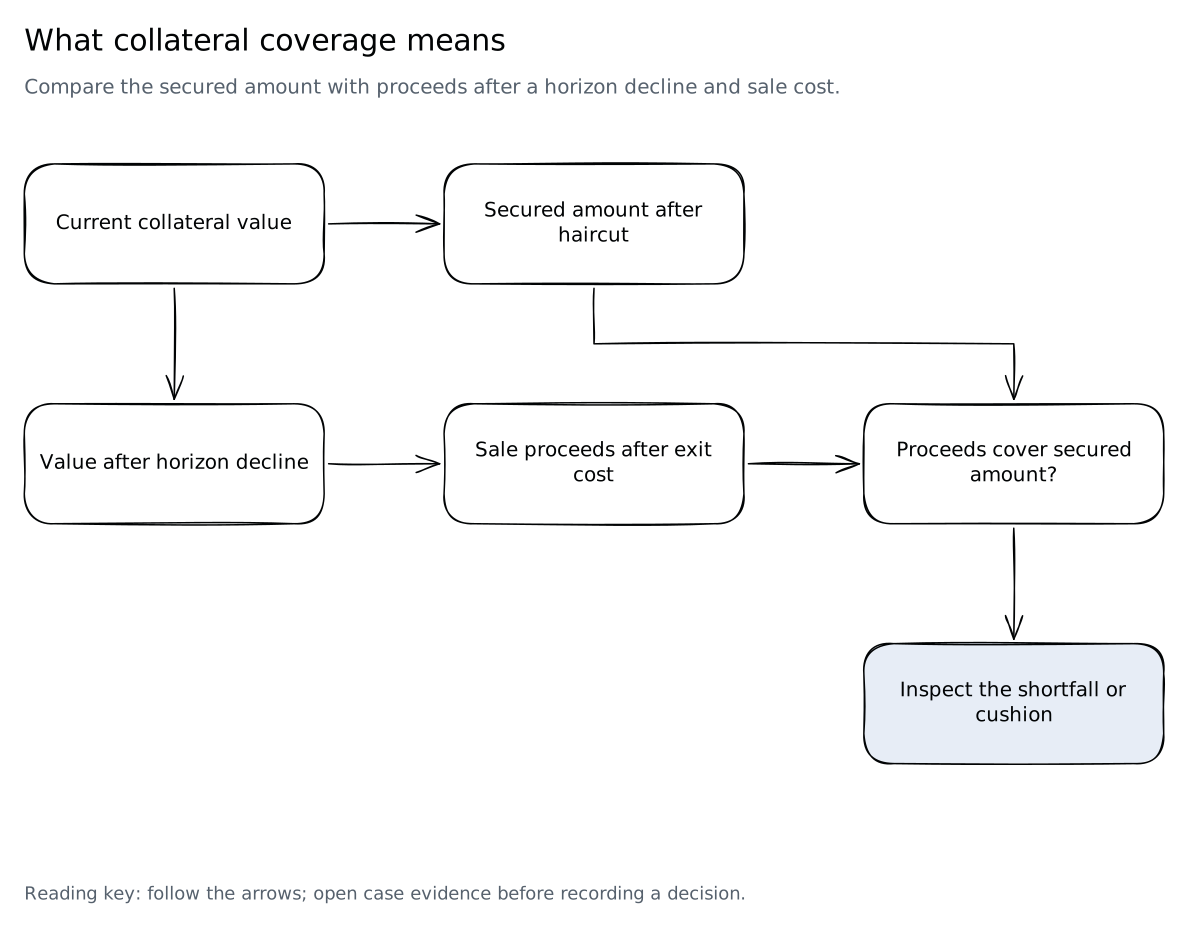
Read the decision flow
- Haircut determines the secured amount
- Stress changes the collateral value
- Exit cost reduces sale proceeds
- Compare proceeds and secured amount
- A historical pass is a diagnostic, not a guarantee
30 ideas, 6 controls
05 · Where the controls came fromIn July 2025 I published 30 widget ideas for a risk dashboard across 3 posts, written for DeFi analytics: the first 9, 12 more, and a final 9. A dashboard with 30 widgets answers no single question. 6 controls that move 1 number, and know when not to, answer 1.
- Independent price check
- From a price-source health monitor. The node graph with pulsing links became a drift strip with the threshold drawn.
- Cost to exit at size
- From a liquidity stress test. The heatmap of pools became a cost curve by size for the selected asset, with the pledged size marked.
- Stability around a target
- From 2 peg monitors merged into 1 control chart with the floor drawn.
- Release calendar
- From a vesting schedule. The cliff list became releases as a share of free float, stacked by holder type.
- Holder concentration
- From a voting-power treemap, redrawn as ranked bars so shares compare on 1 axis.
- Distance to under-water
- From a liquidation meter. The thermometer became the price ladder and the histogram of historical horizon drops behind the consequence panel.
- The waterfall itself
- A pattern reused from a retired idea: a summary grade with the factor list that proves it. The total is the summary; each bar is a factor with its evidence.
The arithmetic, printed so a reader can add it up: 7 source widgets became 6 controls, because the 2 peg monitors merged, and 23 were retired, 30 in all. The retirements fall into 3 groups: 11 built for retail or speculative purposes, 6 that duplicated a live case or a kept control, and 6 with no institutional decision attached. One retired idea is worth crediting: it drew the only confidence band in the series, and that band survives here as the distribution of historical drops behind the consequence panel. The full ledger, 1 row per widget with a reason, sits in the build’s supporting materials.
Who reads the itemized haircut
06 · AudienceA haircut that must be defended line by line is read by several desks for different reasons.
- Collateral analyst
- Needs a haircut they can defend line by line: a base for the class, an add-on per risk, and the evidence behind each one.
- Credit officer
- Needs the counterparty’s exposure after the haircut and the limit, on 1 row per asset.
- Treasury or financing desk
- Needs the funding cost of a haircut that is too high, which the surplus and shortfall make explicit.
- Model risk and price verification
- Needs the price source and the rule behind each risk: the threshold, the window, and the rounding, all stated.
- Audit
- Needs every lever choice in the schedule with its reason, in 1 line each.
Where this transfers
07 · Same shape, other fieldsAny number that gates a decision, and carries hidden arguments inside it, reads better itemized with its levers named.
- Mortgage and loan valuation
- A loan-to-value number decomposed into appraisal, liquidity, and concentration arguments, with some risks moved to covenants.
- Insurance reserving
- A reserve itemized by its drivers, with the uncertainty of each driver left visible.
- Inventory financing
- Advance rates by evidence, with limits per supplier instead of a deeper blanket haircut.
- AI model scorecards
- An aggregate score shown as the sum of its tests, with some failures handled by scope limits rather than a lower score.
3 decisions
08 · Trade-offs- Additive risks
- Easy to read and easy to contest: each bar is 1 rule with 1 evidence panel. The price is that real risks interact; a concentrated holder base also makes exit cost worse. The model says so in its honesty block and does not pretend to capture it.
- 4 levers instead of 1 number
- More to explain than a haircut table. In exchange, a size problem solved with a size limit leaves the class haircut honest for everyone else, and a known event gets a date instead of permanent points.
- A waterfall over a scorecard
- Wider on the screen than a single grade. Each bar is a claim that can be opened, and its lever shows how it was handled, which a grade cannot carry.
Analysts may leave every risk on haircut points because the default needs no reason. The study counts non-default levers and their reasons; if almost no one uses them, the next version asks for 1 line on every lever, default included.
What the model establishes
Coverage is measured on the supplied historical sample with overlapping windows. It describes this sample rather than an independent out-of-sample guarantee. Liquidity and concentration adjustments are policy levers; their effects should be validated separately from the price-loss percentile.
What I would measure
09 · The study this needsThe workspace makes an argument. It does not yet have evidence from users. This is the study I would run, with the pass line set before any session.
- Participants
- 5 to 8 collateral, credit, or financing analysts.
- Task
- Set terms for the 6 assets in this workspace, and with a class-schedule table plus a price chart, with the order counterbalanced.
- Measures
- Which of the price-stale mark, the coming release, and the concentrated holder base each participant catches; the lever chosen for each risk; the terms set; time; and an expert rating of each written reason.
- Pass line
- More history-blind risks caught than with the table, with no increase in time beyond 30%. If the levers go unused, the next version asks for a reason on every lever.
How it is built
10 · Stack and craft- A single-page workspace with local D3 and hand-built SVG. No framework, no network calls. It runs from disk as well as from a server.
- 1 seeded generator and build step write the data file, so the waterfall, the evidence panels, and the numbers on this page agree. Reruns are byte-identical.
- Every assumption is editable in the tool, labeled as an assumption for the study, and listed in a session change list.
- The schedule exports as CSV and JSON with a designed-data flag. Deep links select asset, view, evidence, and routed state.
- Keyboard path through every control, labeled bars, radio-group lever cards, the schedule table as the waterfalls’ text twin, a 12px floor on every axis and bar label, and nothing animates. Built to a WCAG 2.1 AA target, not audited.
- Diagram sources: editable Excalidraw files with SVG and PNG exports.