
Principal Product Designer · Fintech, Capital Markets and Decision Intelligence
I design trading, risk, and compliance interfaces where misreading the data has capital consequences.
15 years across UBS, CME/NYMEX, Refinitiv, KKR, Jupiter, and Tassat. I turn high-stakes workflows into auditable, buildable products.
Across climate risk, options trading, workforce planning, clinical benchmarking, and talent mapping, the same failure repeats: dense model output is easy to misread, and the consequence lands in capital, risk, headcount, hiring, and decisions that are expensive to reverse. That misread is the problem this portfolio is built against.
How I work
I design institutional decision-intelligence systems that expose the mechanism behind the answer, keep uncertainty legible, and make the next action auditable by design. I work embedded with the people who own the decision, doing product discovery on their floor rather than from a brief.
I design in Figma, and I do not stop at Figma. I use AI coding agents to turn strategy into functional React and TypeScript prototypes, and Mermaid for declarative diagramming of decision flows, so teams build from working logic, not static specs.
Reveal the mechanism
Decision interfaces that show what drives the recommendation, which assumptions matter, and where the model stops being certain.
Keep uncertainty visible
Probabilistic systems should not be flattened into fake certainty. Range, confidence, and consequence stay legible in the interface.
Support auditable action
Each screen becomes a decision artifact a portfolio manager, operator, or staffing lead can defend in a real review.
Selected prototypes
3 of 18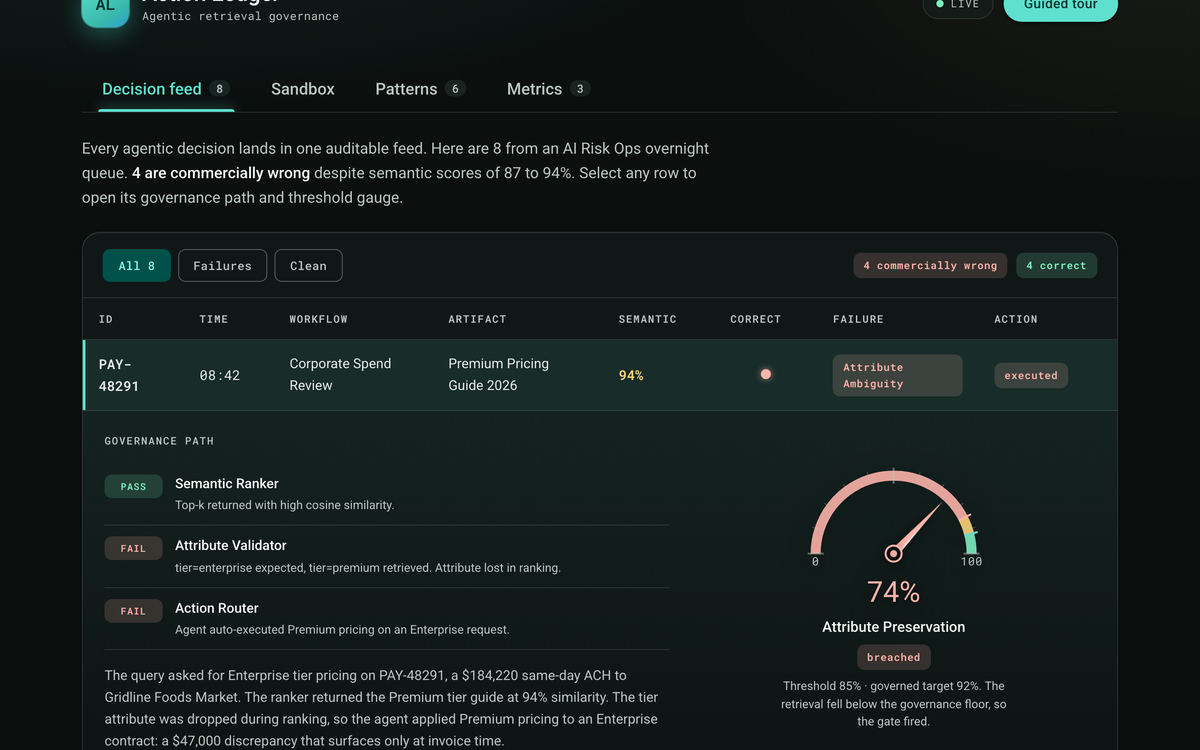
Similarity Is Not Correctness
A calibrated decision boundary where semantic similarity is not allowed to become unsafe action. Agentic retrieval can return something close enough to sound right and wrong enough to cost money. The core decision was to calibrate one reversible, self-auditing boundary instead of stacking gates, trading throughput for accountability.
- AI governance
- Retrieval risk
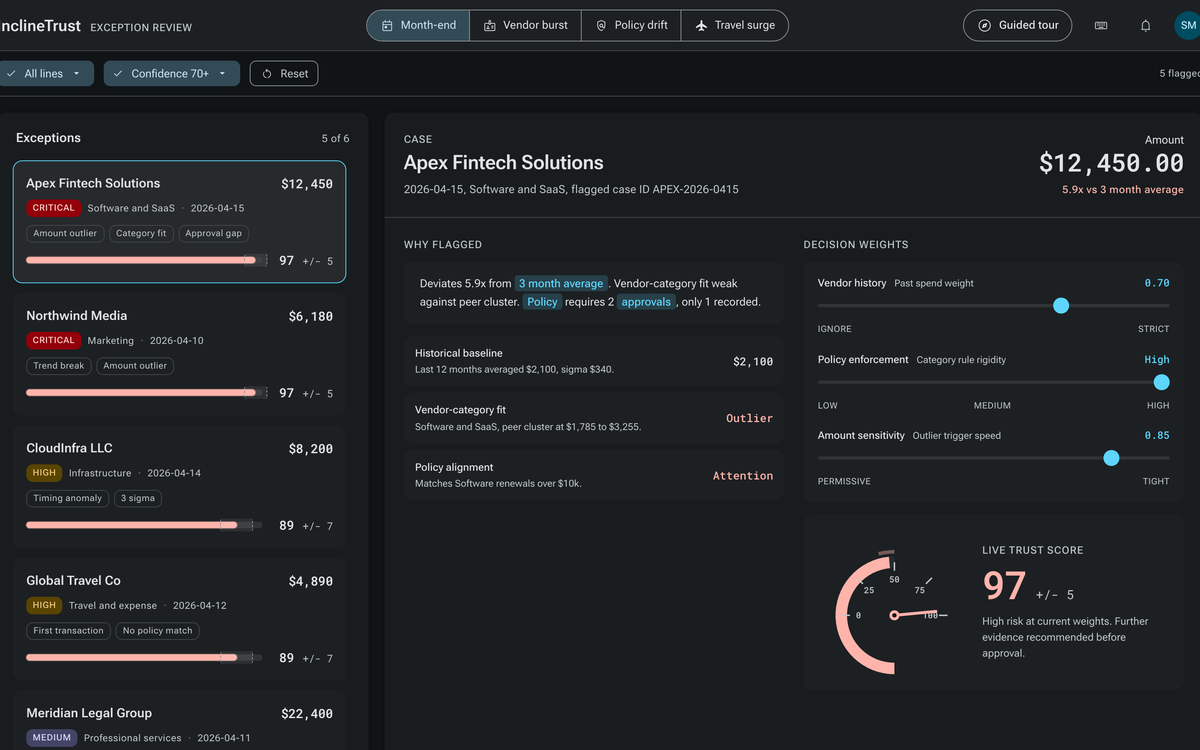
Incline Trust
A reviewer workspace for an AI-driven corporate spend and payments platform. The interface makes the model legible enough that a controller can accept, adjust, or reject each call under a tunable confidence band, then emit an immutable, auditable record without leaving the page. The inbox is ranked by confidence band rather than point score.
- Finance operations
- Reg-tech
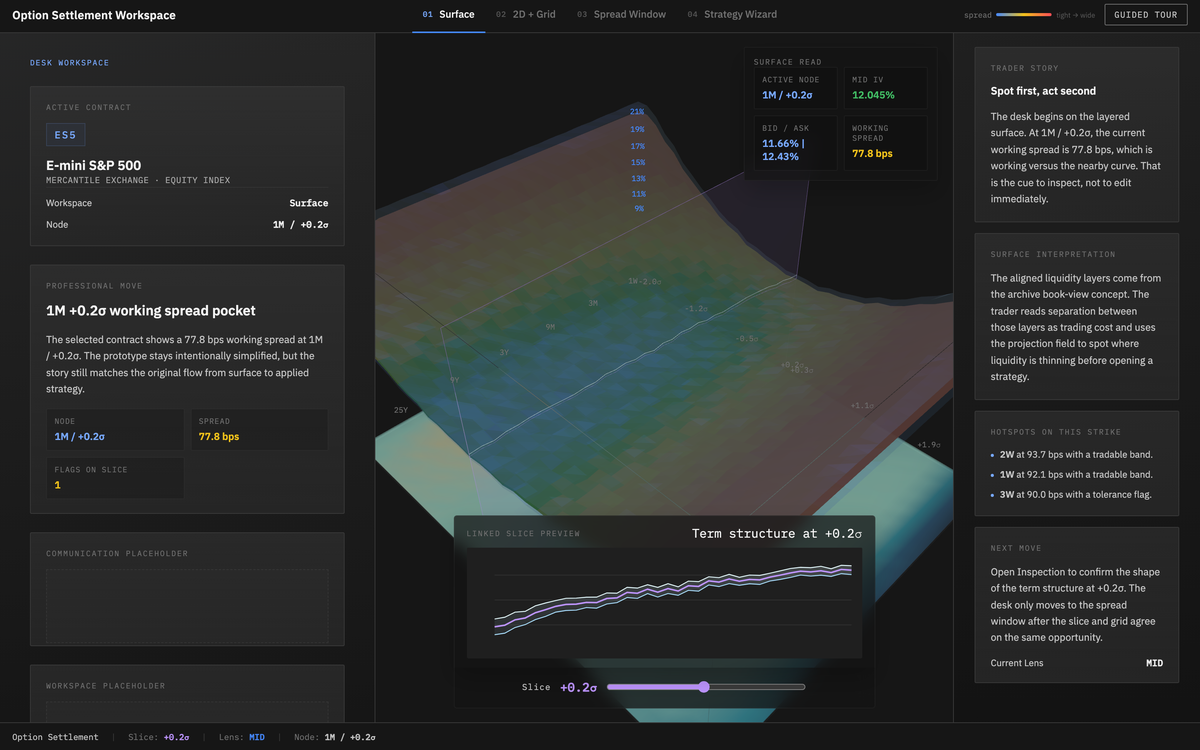
Volatility Surface
A linked decision-intelligence workspace for options traders. It holds one market context across surface, slice, grid, spread, and strategy views, with a stress-calibrated value-at-risk gauge, so the desk reads the field correctly by design. Screen density gave way to coherence.
- Capital markets
- Risk visualization
More work
15 cases
Uncertainty as Signal
Climate-risk disclosure UI for Tier 1 banks and insurers, wired to live climate models.
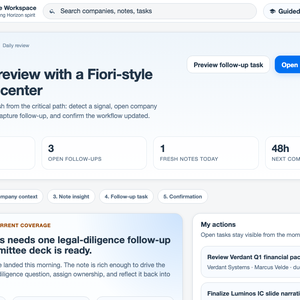
North Bridge
Signal triage, company context, notes, and follow-ups unified into one coverage workflow.
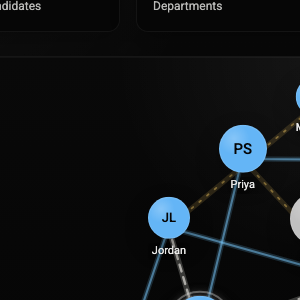
Know Who Knows
Enterprise talent mapping that makes the topology of expertise visible across a 200-person pool.
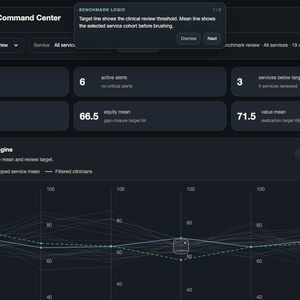
What Gets Measured
Exception-led clinical benchmarking command center across 101 physicians and 4 years of data.
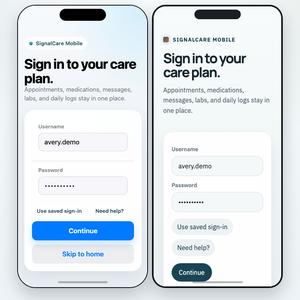
Decision Logic Before Build
iOS and Android clinical prototype sharing one state machine to catch logic errors pre-build.
HR as DJ
Founder-built workforce planning product turning staffing uncertainty into actionable operating moves.
Quiet Signal
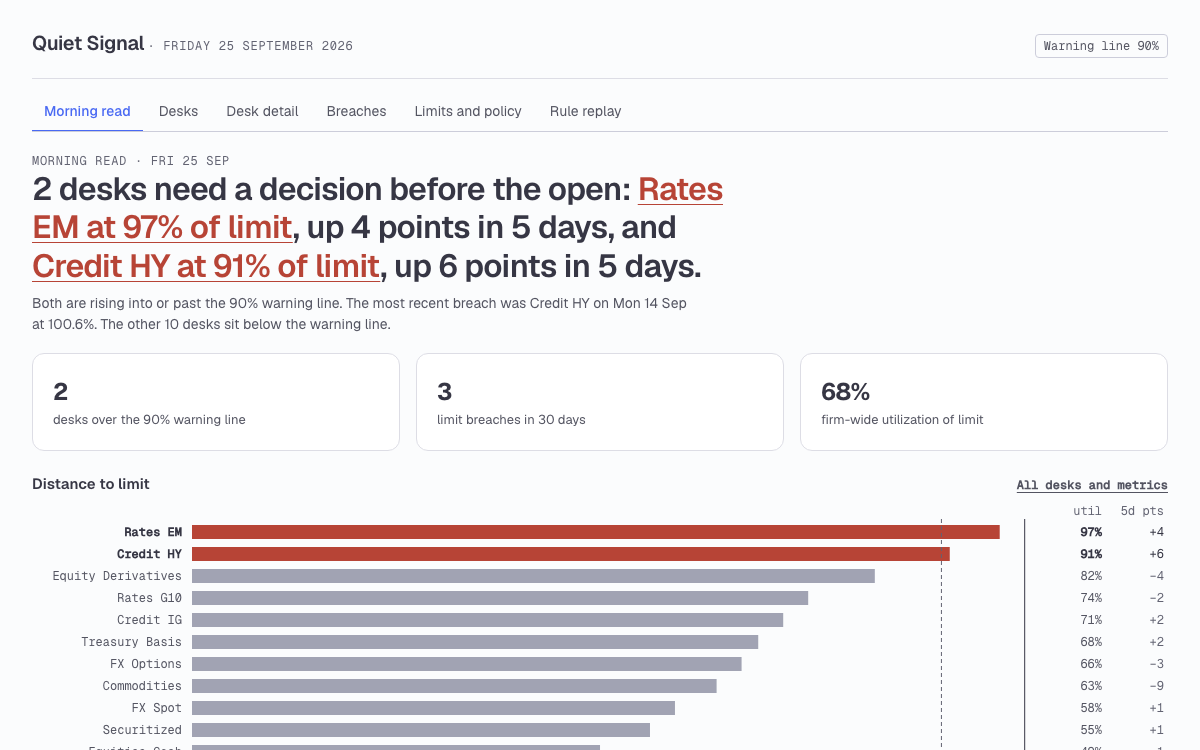
A risk-limits monitor cut down to 1 sentence and 3 tiles, with a log of what each of 9 removals cost.
Tail Mass
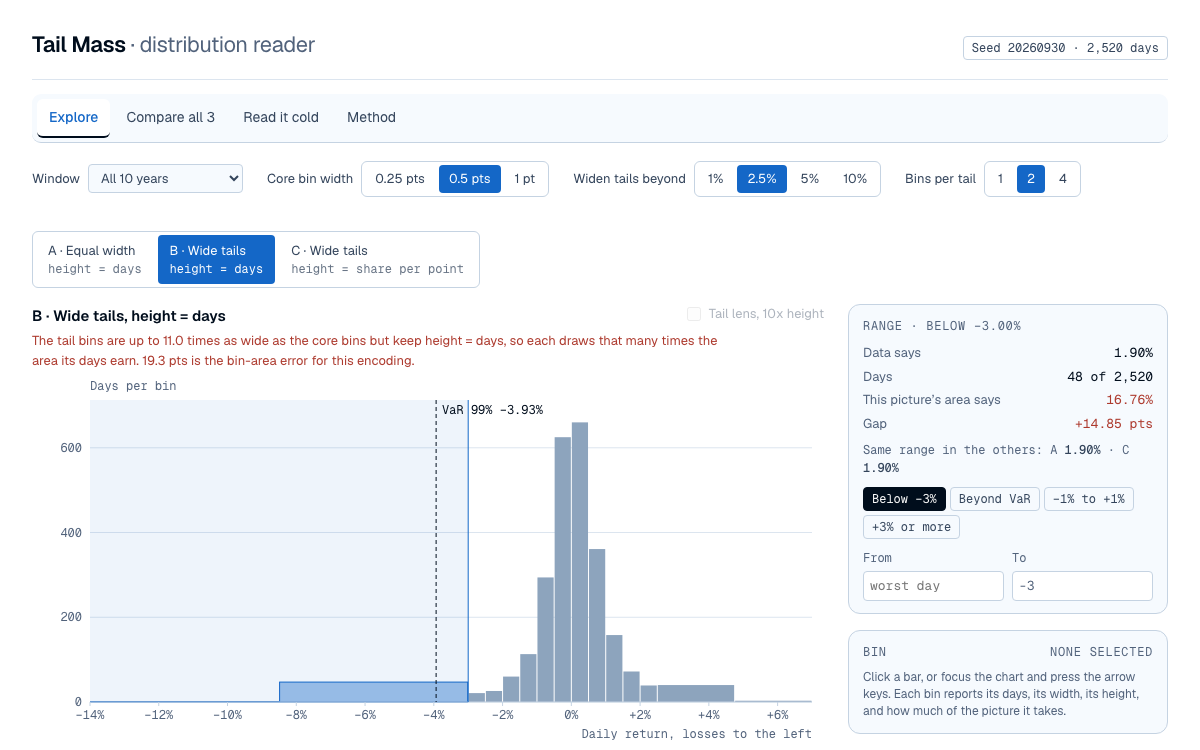
The same 2,520 days drawn 3 ways, with the share of each histogram that sits in the wrong place.
Itemized Haircut
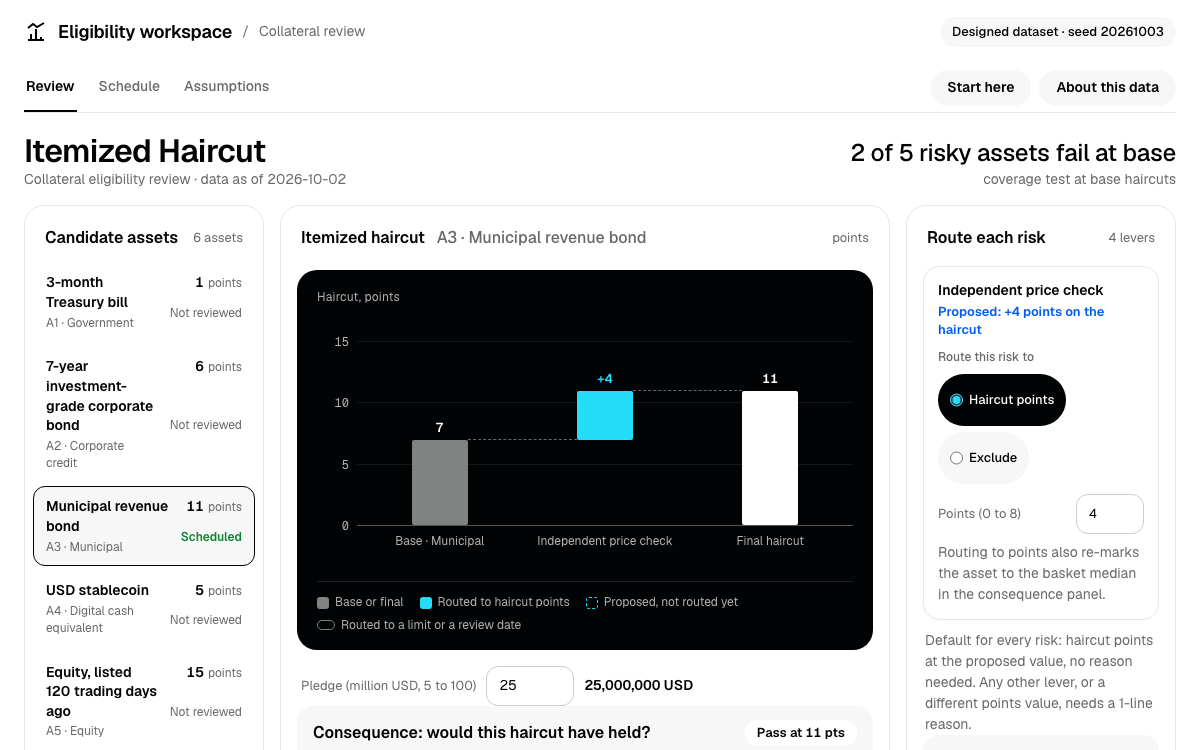
A collateral haircut drawn as the sum of its evidence, with each risk routed to points, a size cap, a review date, or exclusion.
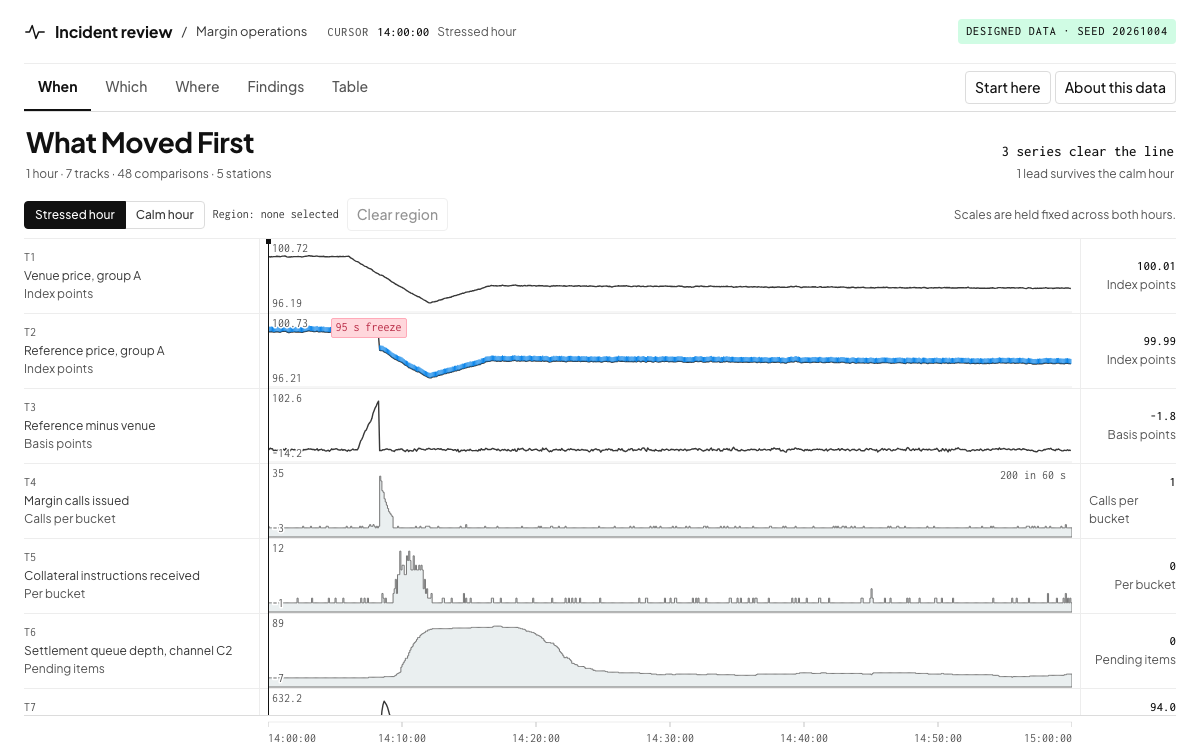
What Moved First
An incident review that records no finding without a direction check and a calm hour to compare against.
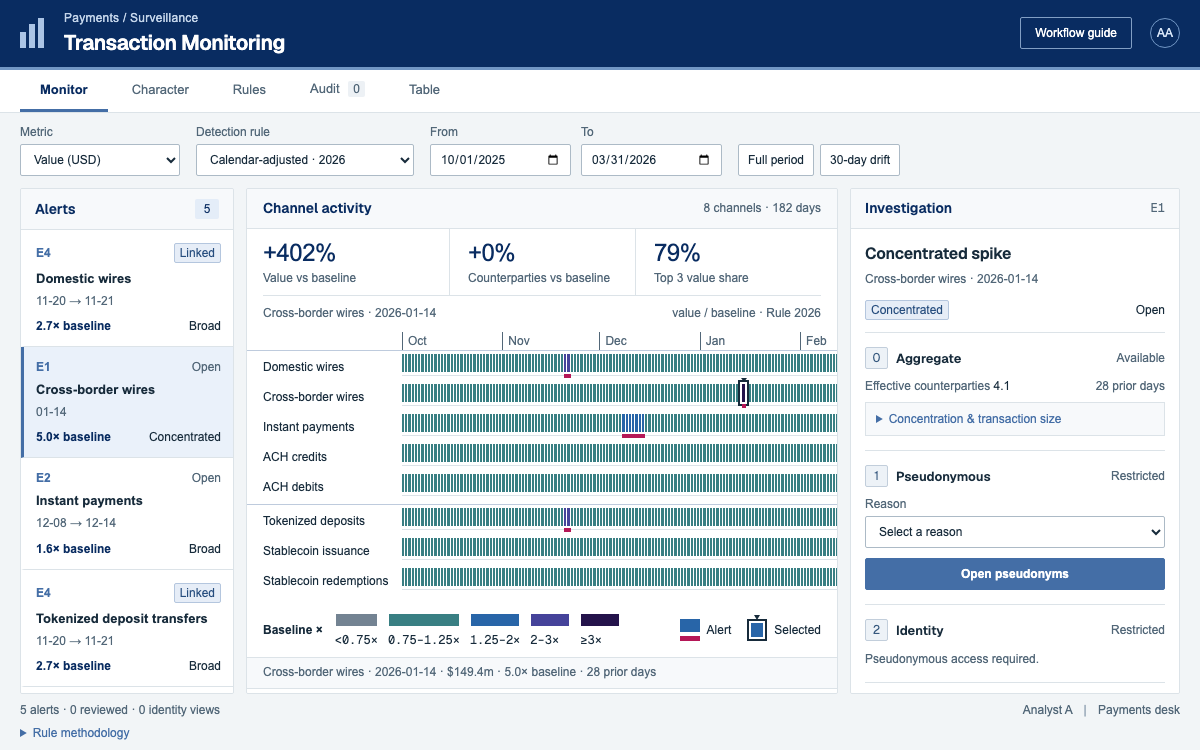
Watch the Market, Not the User
Transaction monitoring that starts at the aggregate, where every look at an individual needs a reason and leaves an audit line.
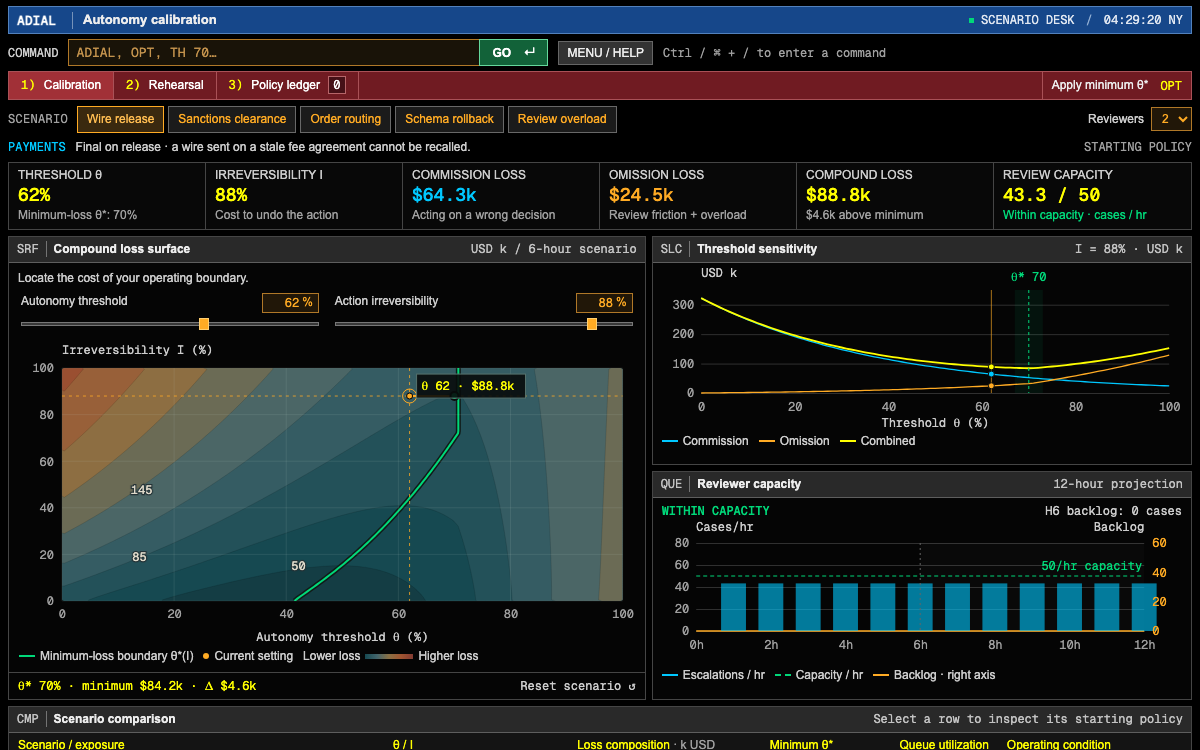
The Autonomy Dial
Where an AI agent acts alone and where it waits for a person, priced in irreversible errors and review-queue capacity.
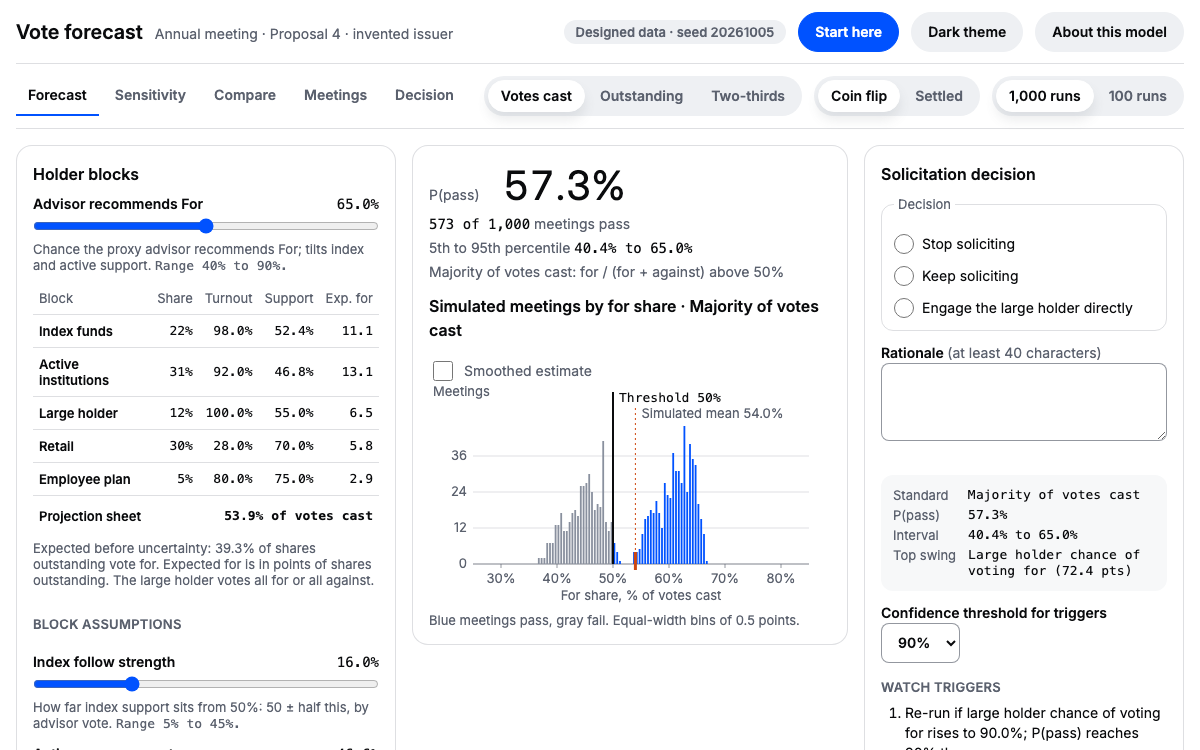
Landslide or Coin Flip
A proxy vote forecast that reads 54% against the standard that applies and names the assumption that decides it.
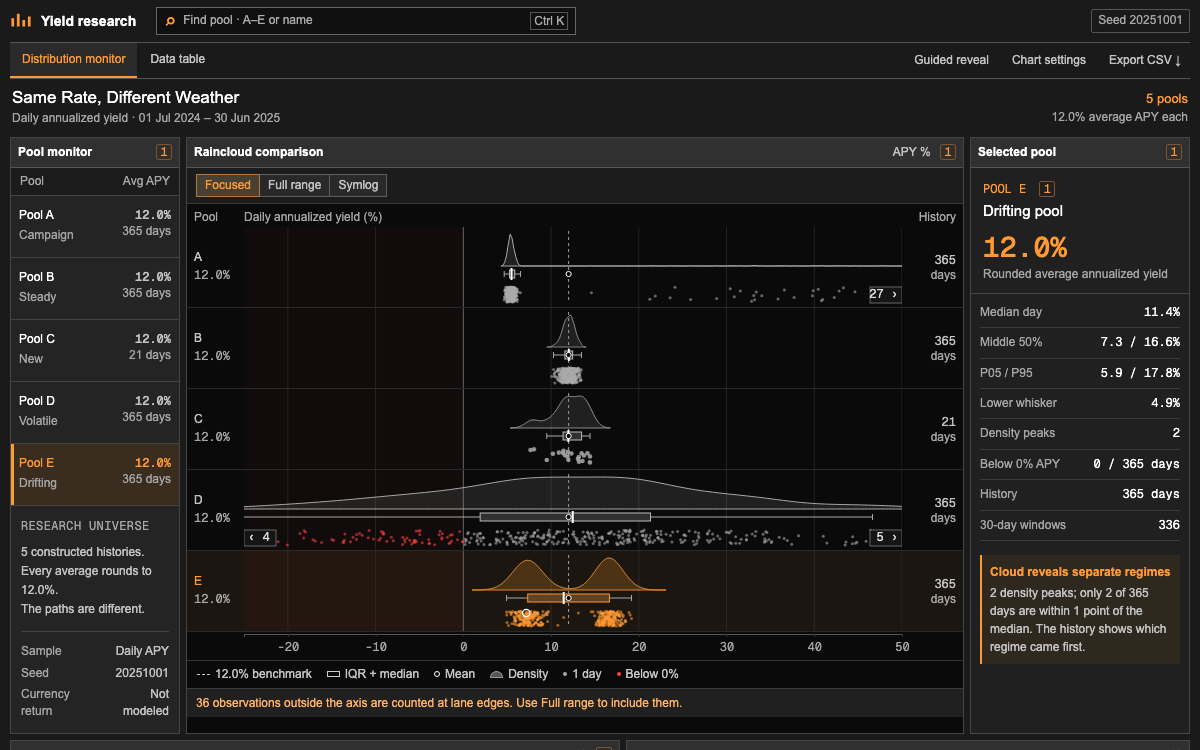
Same Rate, Different Weather
5 pools with the same 12.0% average, and the distribution and history that tell them apart.
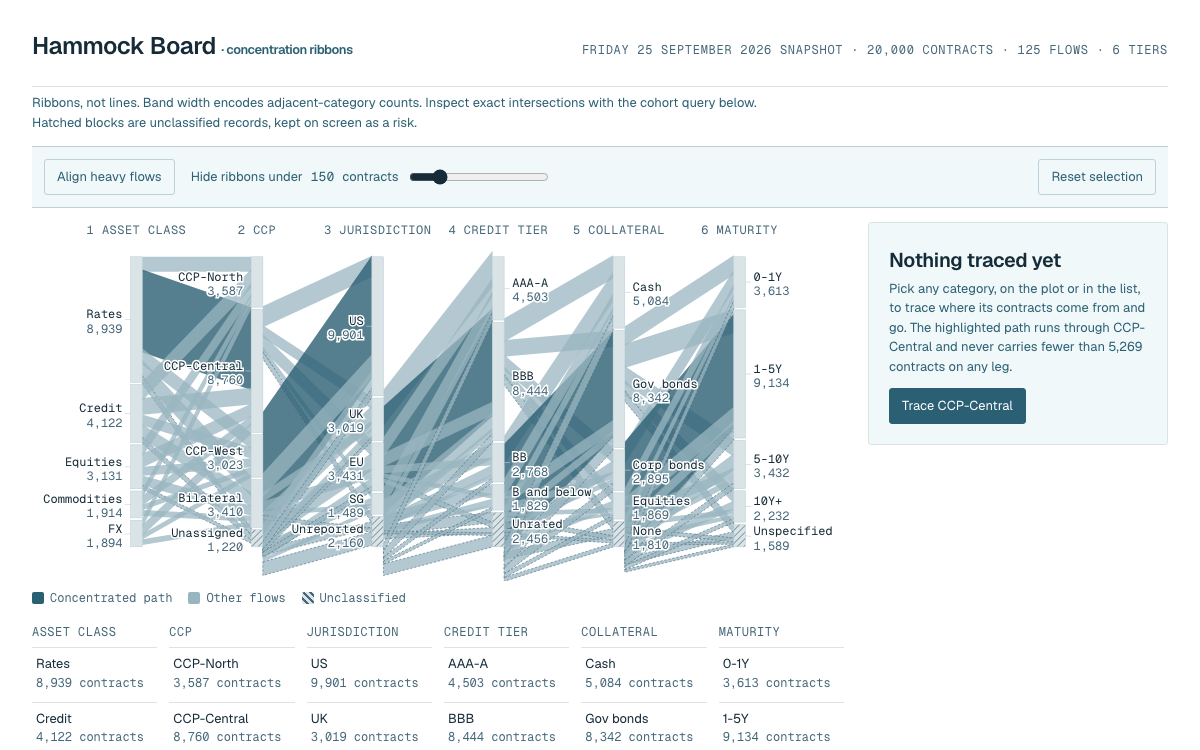
Hammock Matrix
20,000 contracts across 6 classifications as ribbons, with exact cohort counts and the unclassified kept in view.
Where misreading breaks decisions
The through-line in this portfolio is not the industry. It is what happens when people misread dense information under pressure. The stakes are measured in capital, risk, and decisions that cannot be undone.
- Climate risk
- 22,000 probabilistic data points per asset can turn into incorrect investment calls, so the interface keeps uncertainty visible instead of collapsing it to a single number.
- Options trading
- Traders misread the volatility surface and commit capital on the wrong read, so one market context is held across slice, grid, spread, and strategy views.
- Workforce planning
- Staffing uncertainty gets flattened into false precision and headcount is misallocated, so an allocation model turns uncertainty into actionable moves.
- Clinical benchmarking
- Exception patterns are missed and care-quality risk stays hidden too long, so the command center leads with exceptions, not averages.
- Talent mapping
- Candidates are misread because expertise is treated like a list instead of a network, so graph navigation makes the topology of expertise visible.
- Finance operations
- AI-flagged exceptions get rubber-stamped or ignored and audit defensibility erodes, so the reviewer workspace keeps model uncertainty visible and welds each verdict to an immutable audit artifact.
Experience and scale
15 years designing decision interfaces across capital markets, climate risk, and enterprise data products, as a hands-on individual contributor and as a design leader building teams, systems, and user research practice.
Career chronology
- Jul 2026 to present
- Principal Product Designer, S&C Advisory and Venture Studio. Product design for fintech and AI decision interfaces.
- Oct 2025 to Jul 2026
- Head of Product Design and UX, AI Media. Lean UX and Design Sprint practice for hardware-encoder and digital product interfaces.
- 2024 to 2025
- AI-Augmented Product Designer, S&C Advisory. End-to-end product design for fintech clients using AI-assisted design and development workflows.
- 2024
- Product Designer (contract), Tassat. Redesign of a blockchain-based financial trading platform.
- 2023 to 2024
- Independent Design Consultant. Fintech and enterprise UX engagements; 6 React and TypeScript interactive experiences for risk visualization, anomaly detection, and decision support.
- 2022 to 2023
- UX Designer, Design Systems and Data Visualization, Jupiter Intelligence. Data-visualization tools and design-system standards for an enterprise climate-risk platform.
- Jul 2020 to Dec 2021
- Independent Design Consultant. Maintained design and product-delivery continuity for US clients through the relocation of Eastern European IT talent, re-establishing distributed teams in new locations.
- 2019 to 2020
- Senior Product Designer, ElectrifAi. AI and ML analytics interfaces; shipped 8 dashboards serving 500+ users.
- 2010 to 2019
- Senior UX Designer, EPAM Systems. Embedded on-site with UBS, CME/NYMEX, Refinitiv, KKR, Thomson Reuters, and Google. Key work: CME/NYMEX 3D volatility-surface analytics, UBS NEO execution platform, Refinitiv 200+ component enterprise design system.
About
I work at the intersection of financial data, institutional decision-making, and complex information systems. I was building data-heavy institutional design systems before consumer UX was a category. The common thread is not the domain. It is the user: someone who must make a high-stakes call using a model they did not build, on a timeline they cannot control.
I design in Figma and ship from Figma to React and TypeScript via AI coding agents, turning strategy into working risk meters, anomaly dashboards, geospatial climate maps, and retrieval-first portfolio shells. I use Mermaid for declarative diagramming of decision flows. I do not just design screens. I hand teams working logic, not static specs.
I previously founded Staffing Radar, a workforce analytics application built around a custom mathematical allocation model. I built the product, the model, and the interface, then shipped it. Active in the NYC tech community as a speaker since 2013.
Anthropic certifications: 4, listed with dates on the resume.
Selected clients and contexts: UBS (investment banking and trading platforms) · Chicago Mercantile Exchange (derivatives exchange) · Refinitiv (financial data and infrastructure) · KKR (alternative asset management) · Thomson Reuters (legal and financial intelligence) · Google (design sprints, DoubleClick for Publishers). Capital-markets client work delivered embedded via EPAM Systems, 2010 to 2019.
Siarhei Mardovich is a Principal Product Designer with 15 years in fintech and capital markets (UBS, CME, Refinitiv, KKR via EPAM). He works embedded with users and ships from Figma to working React and TypeScript prototypes built with AI coding agents. He designs AI decision systems and decision-intelligence interfaces that keep uncertainty legible, holds 4 Anthropic certifications, and is open to principal and staff product design roles in the Greater New York City Area.